Wood Slat Ceilings with Acoustic Panels
A slat ceiling is one of the most effective places to put acoustic panels, because the ceiling is usually the largest bare surface in a room. Run the slats along the room's longest dimension, plan lights and vents first, and fix every panel into framing.
Why the ceiling
In most rooms the ceiling is the biggest hard surface that nobody touches. Treating it does three things at once:
- Absorbs sound where the floor below reflects it back up. A hard floor and a hard ceiling bounce sound between them, and breaking that pair helps.
- Leaves the walls free for art, shelving, windows and furniture.
- Stays out of the way, so panels do not get knocked.
Rooms where it works well
| Room | Why |
|---|---|
| Open-plan living and kitchen | Large hard floors, lots of echo, walls broken up by openings |
| Home office or studio | Reduces the echo your microphone picks up |
| Home theater | Absorbs a major early reflection above the seats |
| Basement | Hides joists and ducts, and adds warmth |
| Dining room | A panelled area above the table defines the zone |
Keep panels out of bathrooms and any space above a cooktop. See bathrooms and kitchens.
Full ceiling or a zone
- Full ceiling. Strongest effect, most panels, most work around lights and vents.
- A zone. A panelled rectangle above a dining table, a sofa or a desk. It defines the area and treats the sound where people sit. Finish the edges with trim.
- A strip. A band running the length of a room, often with a light in the middle. Least work, mostly decorative.
Which way to run the slats
- Along the room makes it feel longer.
- Across a narrow room makes it feel wider.
- Line them up with a feature, such as a kitchen island, a long window or a hallway, so the eye follows the slats toward it.
On a full ceiling, also think about where joints between panel lengths will fall. Stagger them, or set them on a line that already exists, such as a beam.
Plan the ceiling before you order
- Lights. Recessed lights need cut-outs. Some fittings give off heat and need clearance from combustible materials, so check each fitting’s instructions. Slim surface lights or a linear light between slats are alternatives.
- Vents, smoke detectors and sprinkler heads must stay uncovered and work as before. In a building with sprinklers, check before fixing anything below the ceiling.
- Access panels for plumbing or wiring above need to stay reachable.
- Ceiling height. Battens and panels together take an inch or two. In a low basement that matters.
Mark all of these on a plan of the ceiling. It makes the panel count more accurate and saves cuts.
Fixing
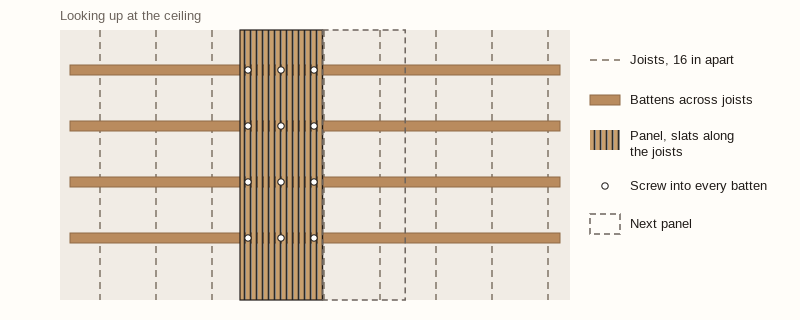
Overhead, every screw carries load, so the rules are stricter than on a wall: framing behind every fixing, no drywall anchors, no adhesive on its own. The full method is in how to install slat panels on a ceiling.
Battens across the joists are the easier route and leave an air gap behind the panels. In published test data, that gap substantially increases absorption at speech pitch. See do slat panels work.
Finish
A dark finish lowers a ceiling visually. In a room with ordinary ceiling height, natural oak or white oak keeps the room bright. Walnut or black overhead suits high ceilings, media rooms and spaces where you want a cosier feel. See the finish comparison.
Count your panels
Treat the ceiling like a wall: enter its length and width in the panel calculator, setting the slat direction to match your plan. Subtract nothing for small light cut-outs; the offcuts rarely cover them.
Quick answers
Can acoustic slat wall panels be used on a ceiling?
Yes. The same panels are widely used overhead. The fixing has to be stricter than on a wall, with screws into joists or battens behind every fixing.
Which way should ceiling slats run?
Usually along the longest dimension of the room, which makes the room feel longer. Running them across a narrow room makes it feel wider.
Does a slat ceiling reduce echo?
Yes. In a room with hard floors and walls, the ceiling reflects a large share of the sound back down. Covering it with absorbing panels makes a clear difference to echo, especially for voices.