Do Wood Slat Acoustic Panels Actually Work?
Yes, for echo. They absorb a useful share of mid and high frequencies, such as voices and clatter, and very little bass. How you mount them matters as much as the panel. In one manufacturer's test the same panel absorbed about three times as much at 500 Hz on battens as it did stuck flat to the surface.
What the test data shows
A slat panel absorbs sound in two ways. The felt soaks up sound that reaches it through the gaps, and the gaps with the space behind them trap sound at certain pitches. Because of that second part, the space behind the panel changes the result.
One manufacturer, The Wood Veneer Hub, publishes absorption figures for the same panel mounted two ways in its technical sheet. The test followed ISO 354. A value of 0 means no sound absorbed and 1 means all of it.
| Pitch | Fixed directly to the surface | On battens with a 1.8 in gap |
|---|---|---|
| 250 Hz (low voice, hum) | 0.09 | 0.30 |
| 500 Hz (speech) | 0.24 | 0.74 |
| 1,000 Hz (speech, TV) | 0.63 | 1.09 |
| 2,000 Hz (clatter, consonants) | 1.09 | 0.85 |
Values above 1 are normal in this kind of test. They come from the panel’s edges adding to its working area.
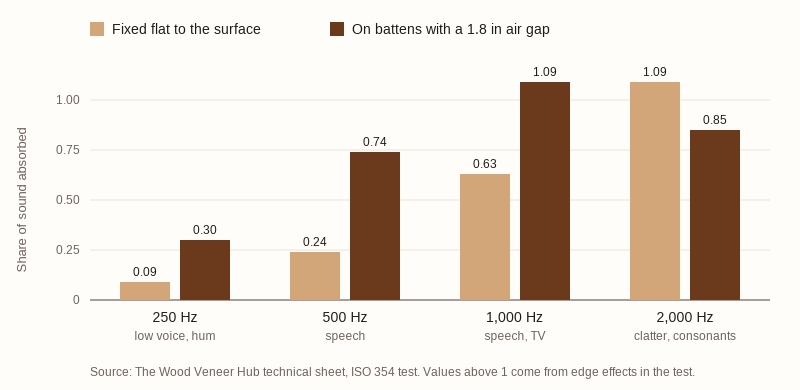
Averaging the four pitches the way an NRC rating does gives about 0.50 for direct mounting and about 0.75 on battens. That is our own arithmetic, and the original test was ISO 354, not the ASTM C423 test that US ratings use, so read it as a guide to scale.
What that means in a room
- Speech and TV sound get clearer. The panels work best from about 500 Hz upward, where most of what makes speech understandable sits.
- Bass is barely touched. At 250 Hz and below, absorption is low however you mount them. A booming subwoofer needs thick bass traps.
- Battens beat glue. If you care about the sound and not only the look, mount on battens. The same sheet says that filling the gap with mineral wool improves the result again.
- Coverage matters. One accent wall in a large open room helps a little. A common rule of thumb in room acoustics is to treat somewhere between 15 and 30 percent of the room’s surfaces.
Claims to be careful with
- “Soundproof.” No slat panel is. See sound absorbing versus soundproofing.
- A single NRC figure with no mounting method. The same panel can honestly score 0.50 or 0.75. A listing that says 0.90 and does not say how it was tested is not telling you much.
- “Up to 85% absorption.” That may be true at one pitch on one mounting. It is not an average.
When they are the right choice
Slat panels suit a room where you want a finished wall and less echo in one step: a living room with hard floors, a home office used for calls, a media wall. If sound quality is the only goal, plain fabric-wrapped acoustic panels absorb more for less money. If the problem is noise from another room, you need mass and sealing, which panels do not provide.
Quick answers
Do wood slat acoustic panels reduce noise?
They reduce echo inside the room, which makes speech clearer and the room feel quieter. They do not stop noise coming through the wall from next door.
Are acoustic slat panels worth it?
For a room that sounds hollow, such as one with hard floors and bare walls, a slat wall gives a clear improvement and a finished look in one step. If your problem is a neighbor's noise, they will not fix it.
What NRC do slat panels have?
It depends on mounting. Published figures for one panel work out to about 0.50 fixed directly to a surface and about 0.75 on battens with an air gap. Be wary of a single number quoted with no mounting method.