Sound Absorbing vs Soundproofing: What Slat Panels Can and Cannot Do
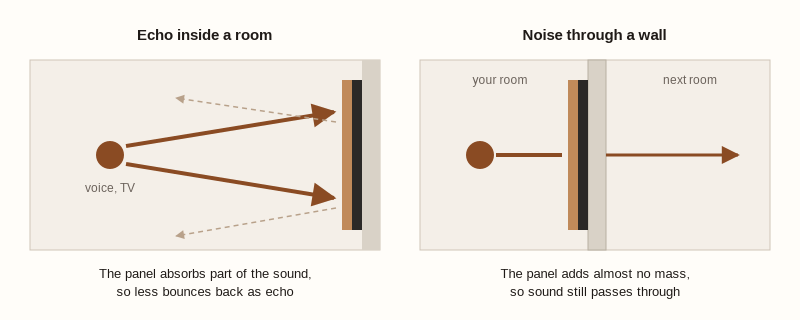
Acoustic panels absorb sound inside a room, so it echoes less. Soundproofing blocks sound from passing through a wall, floor or ceiling. Slat panels do the first job and almost none of the second.
Two different problems
Echo inside the room. Sound bounces off hard walls, floors and ceilings and takes a moment to die away. The room sounds hollow, voices blur and video calls sound like a stairwell. The fix is absorption: soft, porous material that turns the sound’s energy into a tiny amount of heat.
Sound passing through. A neighbor’s TV, traffic, footsteps overhead. The fix is to block it: heavy, airtight construction that sound cannot easily shake.
They are measured differently too. Absorption is rated with NRC, a number from 0 to 1 for how much sound a surface soaks up. Blocking is rated with STC, a number for how much quieter sound is on the far side of a wall. A product with a high NRC can have almost no effect on STC.
What slat panels do
A slat panel is a layer of polyester felt with wood-faced strips on the front. It weighs roughly 25 to 30 pounds over 15 square feet. That is soft and light, which is good for absorbing and poor for blocking.
- Echo: a clear improvement, mostly for voices and higher pitches. See the test data.
- Sound through the wall: very little change. The panel adds almost no mass, and it is not airtight.
What actually blocks sound
If your problem is noise coming through, these are the things that work, roughly from least to most effort:
- Seal the gaps. Sound leaks through any opening air can pass through: under doors, around outlets, along baseboards. Acoustic sealant and a door sweep are cheap and often make the biggest difference.
- Add mass. A second layer of drywall, ideally with a damping compound between the layers.
- Separate the surfaces. Resilient channels or a second stud wall, so vibration in one side does not drive the other.
- Fill the cavity. Mineral wool or fiberglass in the wall helps, mainly once the first three are done.
You can put slat panels on top of a wall treated this way. They will then handle the echo while the wall handles the transmission.
A quick way to tell which you need
Clap once in the room. If you hear a ringing tail, you have an echo problem, and absorption will help. If the room sounds fine but you can hear what is happening next door, you have a transmission problem, and panels are the wrong tool.
Why sellers blur the two
“Soundproofing panels” is a phrase many people search for, so listings use it. It is worth reading past the headline. A seller that publishes test reports with the mounting method stated is describing absorption honestly. A listing that promises to block noise with a felt-backed panel is not.
Quick answers
Do acoustic panels soundproof a room?
No. They reduce echo inside the room. Sound still passes through the wall behind them almost as easily as before.
Will slat panels stop me hearing my neighbors?
Not noticeably. Blocking a neighbor's noise takes added mass, sealed gaps and ideally a wall that is separated from the structure, none of which a light felt-backed panel provides.
Will slat panels stop my neighbors hearing me?
Only slightly. Less echo in your room lowers the overall level a little, but the wall itself lets through as much as it did before.