What Are Acoustic Slat Panels Made Of?
Almost all of them are MDF strips with a thin wood or wood-look face, fixed to a sheet of recycled polyester felt. They are not solid wood. The face material is the main thing that separates a cheap panel from an expensive one.
The three layers
- Felt backing. A sheet of polyester felt about 0.35 inches (9 mm) thick, almost always black or grey. It is the part that absorbs sound, and the part you screw through.
- Slats. Strips of MDF roughly 1 inch wide and under half an inch thick, spaced about half an inch apart.
- Face. A thin decorative layer on the front of each slat. This is what you see.
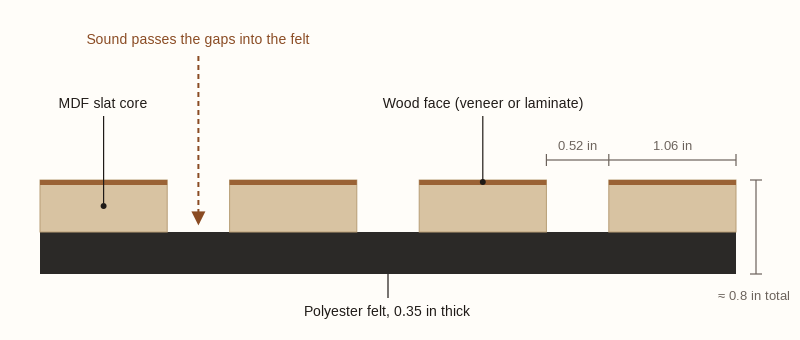
A typical panel is 94.5 by 23.6 inches (2400 by 600 mm), about 0.8 inches thick in total, and weighs 25 to 30 pounds. One manufacturer’s technical sheet lists a 0.35 inch felt and slats of 1.06 by 0.43 inches with a 0.52 inch gap, and other brands are close to that.
The face: three grades
| Face | What it is | How to tell |
|---|---|---|
| Real wood veneer | A thin slice of actual oak, walnut or another species | Grain varies from slat to slat. Costs the most. |
| Engineered veneer | Real wood fibers, dyed and re-formed into a consistent sheet | Very even color and grain. The most common mid-range face. |
| Laminate or wood-look foil | A printed pattern | A repeating pattern. Costs the least. |
All three are sold as “wood slat panels,” so read the listing. For a closer comparison and how to check a sample, see real veneer vs engineered veneer vs laminate. “Real wood veneer” and “natural wood” mean the first. “Engineered” or “technical” veneer means the second. “Wood-like” or “wood-look” means the third.
Also check how much of each slat is covered. On cheaper panels only the front is faced and the sides are painted black. On better ones the veneer wraps three sides, which looks more finished from an angle.
Formaldehyde labels
MDF is made with resin, and resins can release formaldehyde. In the US, composite wood such as MDF must meet emission limits under a federal rule known as TSCA Title VI. The EPA’s guidance says every box or bundle of finished goods must carry a label stating compliance.
- Look for “TSCA Title VI compliant” on the box or in the listing.
- “CARB Phase 2” alone is out of date. The EPA stopped accepting that label by itself in March 2019.
- “E0” or “E1” are European and Asian grades. They are not the US label.
Fire ratings
Interior wall finishes in the US are graded by a test called ASTM E84. Class A is the best, with a flame spread index of 0 to 25. Class B is 26 to 75 and Class C is 76 to 200.
For a house this rarely decides anything. For an office, hotel or shop it can, because building codes set a minimum class for some spaces.
Read the wording closely. Some brands state that the felt backing is Class A. That is not the same as the whole panel being tested. If you need a rating for a commercial job, ask for the test report for the complete panel. At one brand we checked, the version tested as a whole panel cost about 50 percent more than the ordinary one.
What this means when you compare panels
- Compare the face type first. It explains most of the price gap.
- Check the exact width and length. Sizes are not standard between brands.
- Ask for the documents: a TSCA Title VI label, and test reports for any acoustic or fire claim, with the mounting method stated.
Quick answers
Are slat wall panels real wood?
The core of each slat is usually MDF. The visible face may be a thin slice of real wood, an engineered veneer made from real wood fibers, or a printed laminate. Solid wood slat panels exist but are uncommon and cost more.
What is the black backing on slat panels?
Polyester felt, usually made from recycled plastic bottles. It holds the slats together and absorbs sound.
Are slat wall panels safe for indoor air?
MDF sold in the US must meet federal formaldehyde emission limits under TSCA Title VI. Look for a TSCA Title VI label on the box.
Can slat panels go in a bathroom?
Standard panels have an MDF core that swells if it gets wet, so keep them away from showers and splashes. Some brands sell a water-resistant version for humid rooms.