Real Veneer vs Engineered Veneer vs Laminate Slat Panels
Real veneer is a thin slice of actual wood and looks the most natural. Engineered veneer is real wood fiber re-formed into a consistent sheet. Laminate is a printed image of wood. All three get called wood slat panels, and the face type explains most of the price difference between them.
The three faces
Underneath, all three are usually the same: MDF slats on a polyester felt backing. What differs is the thin layer on the front of each slat. See what slat panels are made of for the rest of the panel.
Real wood veneer is a sheet of actual oak, walnut or another species, sliced thin from a log and glued to the slat. Every slat has its own grain.
Engineered veneer, also called reconstituted or technical veneer, starts as real wood, usually a fast-growing species. The wood is sliced, dyed, stacked and pressed into a block, and the block is sliced again. The result looks like oak or walnut with a very regular grain and color.
Laminate, sold as melamine, foil or “wood-look,” is a printed paper or film with a wood pattern, sealed with resin. It contains no wood on the surface.
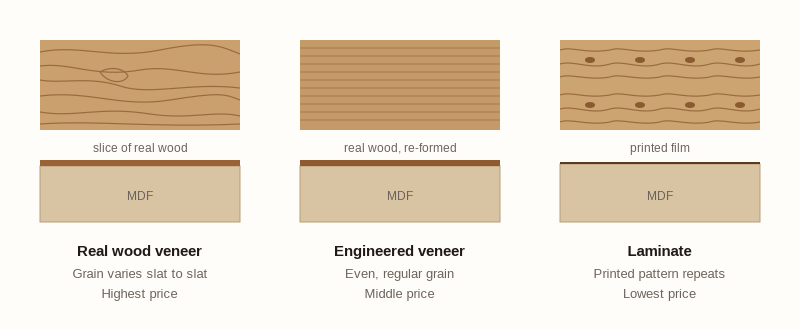
How they compare
| Real veneer | Engineered veneer | Laminate | |
|---|---|---|---|
| Look up close | Natural, varies slat to slat | Even, consistent grain | Printed, may repeat |
| Color between batches | Varies the most | Fairly consistent | Very consistent |
| Fading and color change | Changes with light over the years | Less | Very little |
| Scuff and dent resistance | Moderate | Moderate | Best for scuffs |
| Small repairs | Can be lightly sanded, touched up, re-oiled | Similar to real veneer | Hard to repair invisibly |
| Typical price | Highest | Middle | Lowest |
These are general tendencies. Finish coatings matter too. A real veneer under a tough lacquer can wear better than a thin, cheap laminate.
How to tell them apart in a listing
Sellers do not always say which they use. Look for these words:
- Real veneer: “real wood veneer,” “natural veneer,” “genuine walnut,” “oiled,” “solid wood face.” Sometimes listed with the species name and grade.
- Engineered veneer: “engineered veneer,” “technical veneer,” “reconstituted veneer,” “recon,” or a premium-sounding color name with very even photos.
- Laminate: “melamine,” “wood-look,” “wood-like,” “decor foil,” “printed,” “PVC film” or “wood grain finish” without the word veneer.
If the listing does not say, ask. “Is the face real wood veneer, engineered veneer or laminate?” is a fair question with a one-word answer.
How to tell them apart with a sample
- Look for repeats. Hold several slats side by side. Identical knots or streaks in the same position point to laminate.
- Look at the cut end. Real and engineered veneer show a thin wood layer at the edge. Laminate shows a paper-thin film.
- Check the edges. On cheaper panels only the front of each slat is covered and the sides are painted black. Better panels wrap the face around three sides. This is separate from the face type, and worth checking on any sample.
- Feel it. Laminate is usually smoother and more uniform. Open-grain veneers such as oak have a faint texture you can feel.
Which to choose
- Real veneer if you want the most natural look and like the idea of the wall aging with the room. Order all panels in one batch and accept some variation. See how to clean and maintain a slat wall for oiled finishes.
- Engineered veneer if you want a real-wood surface with an even, predictable look across a large wall. It is the most common choice in the middle of the market.
- Laminate if budget comes first, the wall will take knocks, such as in a hallway or a commercial space, or you want a color that does not exist in natural wood.
One more thing to ask
Veneered MDF panels, real or engineered, are treated as laminated products under the US formaldehyde rules. Look for a TSCA Title VI label. See formaldehyde labels explained.
Quick answers
Is engineered veneer real wood?
Yes, it is made from real wood, usually a fast-growing species that is sliced, dyed and pressed into blocks that are then sliced again. It is real wood with a manufactured grain, as opposed to a printed image.
Which lasts longest?
Laminate resists scuffs and fading best. Real and engineered veneer can be lightly sanded and refinished in small areas, which laminate cannot. Indoors on a wall, all three last for many years if kept dry.
How can I tell laminate from veneer in a photo?
Look for repeats. Laminate prints the same grain pattern again and again, so identical knots or streaks appear on different slats. Veneer, especially real veneer, varies from slat to slat.