NRC Explained: How to Read an Acoustic Panel Rating
NRC is the average share of sound a surface absorbs at four speech-range pitches, from 0 for none to about 1 for all. It depends on how the panel is mounted, so an NRC figure means little unless the mounting is stated alongside it.
What the number is
NRC stands for Noise Reduction Coefficient. A sample is placed in a reverberation room and the lab measures how much faster sound dies away with it there. From that it works out an absorption coefficient at each pitch: 0 means the surface reflects everything, 1 means it absorbs everything.
NRC is the average of the coefficients at four pitches, 250, 500, 1,000 and 2,000 Hz, rounded to the nearest 0.05. Those pitches cover most of human speech. In the US the test standard is ASTM C423.
Rough guide to the scale
| NRC | In plain terms | Typical example |
|---|---|---|
| 0.05 | Reflects almost everything | Painted drywall, glass |
| 0.30 | A little absorption | Heavy carpet on concrete |
| 0.50 | Moderate | Slat panel fixed flat to a wall |
| 0.75 | Strong | Slat panel on battens with an air gap |
| 0.90 and up | Very strong | Thick fabric-wrapped fiberglass panel |
The examples are indicative. Real products vary.
Why mounting changes the rating
Absorbers work better with an air space behind them, and slat panels especially so. A test report always states the mounting. The common ones:
- Type A. Fixed directly against a hard surface. The lowest result, and the one that matches screwing or gluing a panel to a wall.
- Type D. On furring strips or battens, with an air gap. D-20 means a 20 mm gap, D-50 a 50 mm gap.
- Type E. Suspended below a ceiling with a deep air space, such as E-400.
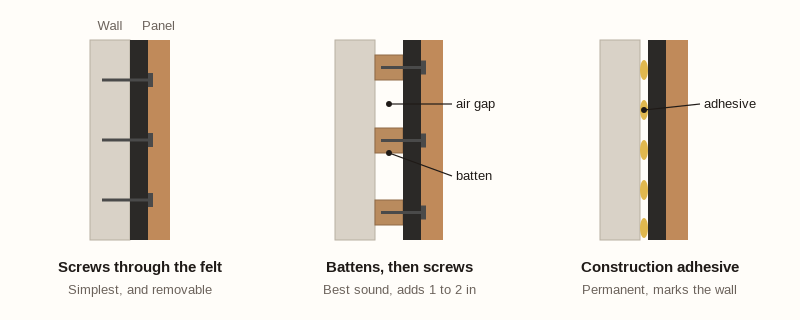
The effect is large. One manufacturer’s technical sheet gives figures for the same slat panel mounted two ways. Averaged the way NRC is, they come to about 0.50 fixed flat and about 0.75 on battens with a 1.8 inch gap. That averaging is ours, and the test followed ISO 354, the international equivalent, so treat it as an illustration.
How to compare two panels
- Find the mounting. If two panels both claim 0.75 and one was tested flat and the other on battens, the first is the better absorber.
- Find the standard. ASTM C423 in the US, ISO 354 elsewhere. A number with no standard is a claim, not a rating.
- Ask for the report. A real test has a report with a lab name, a date and a table of coefficients by pitch.
- Look at 250 and 500 Hz. Almost everything absorbs well at 2,000 Hz. The lower pitches are where panels differ, and where rooms sound boomy.
Claims to be wary of
- A single high figure with no mounting, such as “NRC 0.90.” It may be true with a deep cavity full of insulation. It is not what you get screwed to drywall.
- “Absorbs up to 85% of sound.” This is likely to be the best single pitch, not an average.
- “Class A absorption.” This is a European classification. A slat panel reaches it only with battens and insulation behind.
- NRC used as evidence of soundproofing. See sound absorbing versus soundproofing.
What NRC does not tell you
- Bass. NRC stops at 250 Hz. It says nothing about the low frequencies from music or home theater.
- How much you need. A high-NRC panel covering a small patch does less than a moderate one covering a wall. As a rule of thumb, treating 15 to 30 percent of a room’s surfaces makes a clear difference.
Quick answers
What is a good NRC rating?
For wall panels, 0.50 is moderate and 0.70 or more is strong. Bare drywall is around 0.05, so even a moderate panel is a large change.
Can NRC be higher than 1?
Individual test results can exceed 1, because sound also enters through the edges of the sample. A rating above 1 does not mean more than all the sound is absorbed.
Does a higher NRC mean better soundproofing?
No. NRC measures absorption inside a room. Blocking sound between rooms is measured by STC, which is a different property.