Slat Wall Behind a TV
Make the slat area clearly wider than the TV, ideally the full width of the media unit or the whole wall. Fix the TV bracket through the panels into the studs, and plan the cable route before any panel goes up.
Size the panelled area
A slat area that is the same width as the TV looks like a frame that is too small. Go wider.
| TV size | Screen width | Suggested panelled width | Panels |
|---|---|---|---|
| 55 in | about 48 in | 71 to 94 in | 3 or 4 |
| 65 in | about 57 in | 94 to 118 in | 4 or 5 |
| 75 in | about 65 in | 118 to 142 in | 5 or 6 |
| 85 in | about 74 in | 142 in or the whole wall | 6 or more |
Screen widths are for standard 16:9 TVs. Panel counts use 23.6 inch wide panels. The suggested widths are a design guideline, not a rule. The simplest version of all is to panel the whole wall.
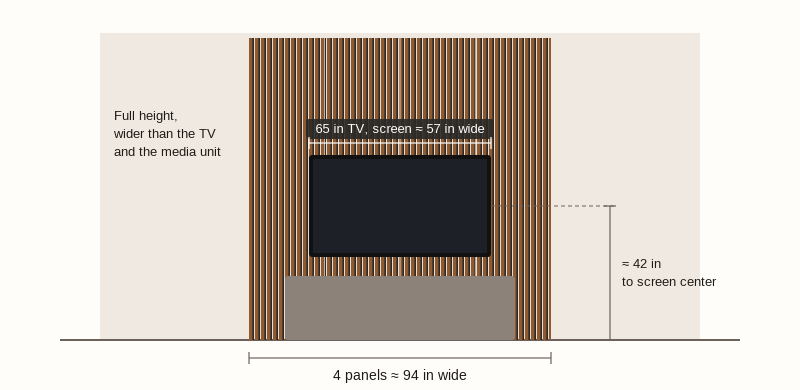
Full height almost always looks better than a band behind the TV. If you stop short of the ceiling, stop at a line that already exists in the room.
Decide the order of work
- Mark the studs and the TV position on the bare wall. Mark the stud lines on the floor and ceiling so you can find them later.
- Sort out power and cables. Fit any new outlet or in-wall cable kit now.
- Fix the panels, cutting holes in the felt for cables as you go.
- Fix the bracket through the panels into the studs.
- Hang the TV.
Details are in how to mount a TV on a slat wall.
The TV hangs from the wall, not the panels
Slat panels are decorative. The bracket’s screws go through the panel and into the studs, and they need to be about an inch longer than usual to allow for the panel’s thickness.
Cables
Nothing spoils a slat wall like a cable hanging down it.
- Best: an outlet and a cable pass-through behind the TV, with a matching one behind the media unit.
- Good: an in-wall cable kit rated for the purpose.
- Acceptable: thin black cables run down a gap between slats, on black felt.
Finish and light
- Black or walnut around the screen cut glare. Light oak is brighter and more reflective around the picture.
- Matte beats gloss. Most slat panels are matte or lightly oiled, which is what you want.
- Bias lighting. A warm LED strip behind the TV or along the top of the wall eases eye strain in a dark room and shows off the texture. See adding LED strips.
Soundbars and speakers
- A soundbar on the media unit works as normal.
- A wall-mounted soundbar needs its own fixings into studs, like the TV.
- Soundbars that bounce sound off side walls and the ceiling are unaffected by panels behind the screen.
Count your panels
Enter the width and height you have settled on in the panel calculator. Set exposed side edges to two if the panelled area stops short of the corners.
Quick answers
How wide should a slat wall be behind a TV?
At least as wide as the media unit under it, and noticeably wider than the screen. For a 65 inch TV, which is about 57 inches across, 4 panels give about 94 inches and look balanced.
What color slat wall is best behind a TV?
A dark, matte finish. Black or walnut reduce reflections around the screen and make the picture look stronger.
Does a slat wall improve TV sound?
Slightly. It reduces sound bouncing off the wall behind the screen, which helps dialogue clarity. It is not a substitute for better speakers.